Introduction
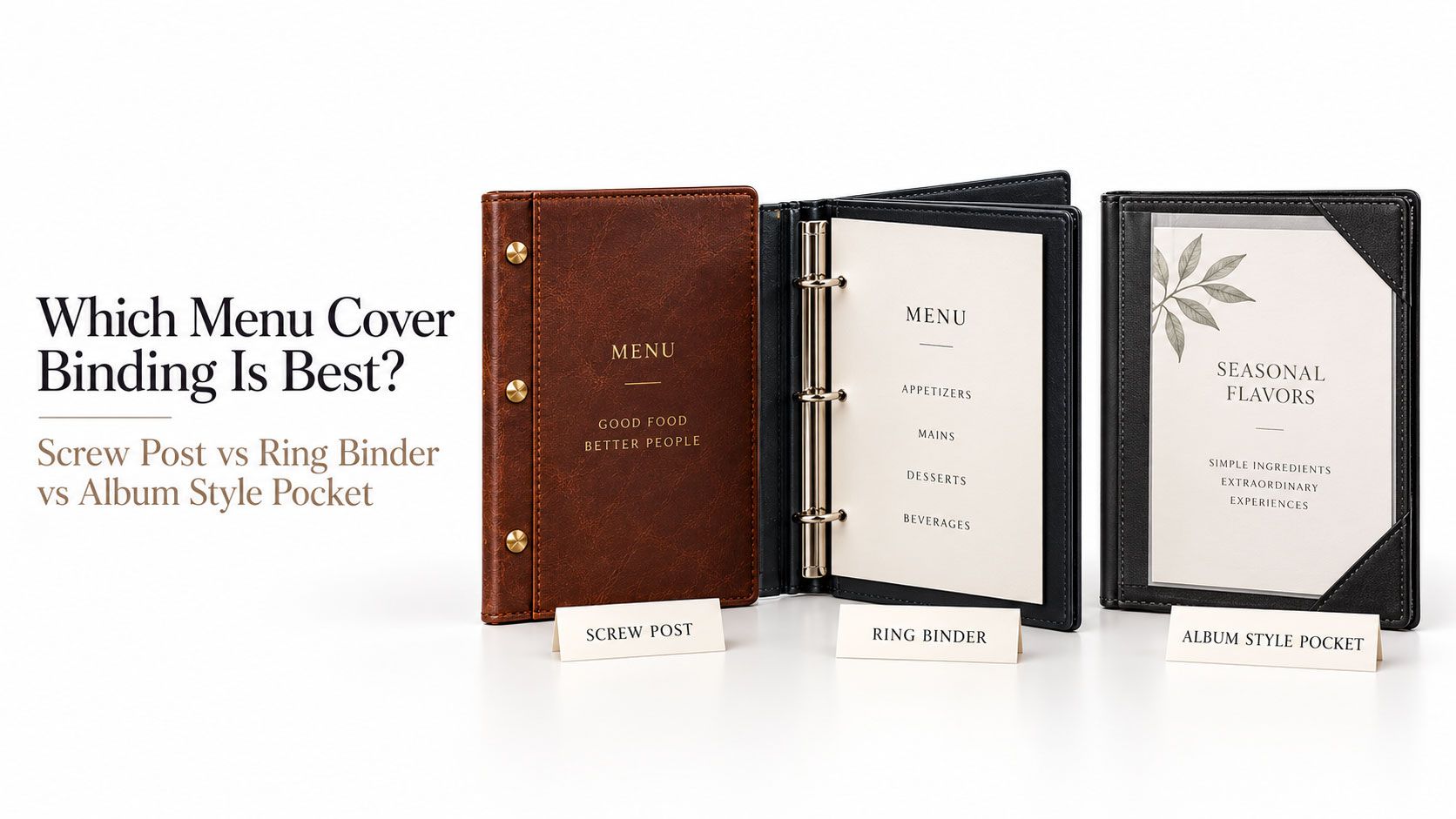
The best menu cover binding is the one that matches how often the menu changes, how many pages it holds, how staff update it, and how guests use it. A screw-post cover can create a refined, book-like presentation, but it is slower to update than a ring binder. Clear pockets are practical and protective, but their visual style differs from a menu held by corners. Elastic cords are flexible and minimal, but page capacity and cord wear must be considered.
Binding is therefore an operational decision as much as a design choice. It affects menu printing, installation preparation, cleaning, replacement parts, staff time, and long-term cost. This guide compares the most common systems for restaurant and hotel menu covers and explains how to test them before placing a bulk order.
Quick answer: Choose screw posts for a polished, low-to-medium frequency update and controlled page set; ring binders for frequent updates or higher capacity; elastic cords for lightweight, flexible booklets; clear pockets for fast replacement and surface protection; and corners or bands for a clean display of individual cards. Test the intended inserts in a production sample before deciding.
Menu Cover Binding Comparison at a Glance
The ratings are relative. A well-designed screw-post system may be easy for trained staff, while a poor ring mechanism can be frustrating. Construction quality and page preparation matter as much as the binding label.
Start With Six Operational Questions
Before comparing appearance, answer these questions with the people who actually change and clean the menus.
A restaurant with a stable seasonal menu may value appearance over changeover speed. A hotel room-service binder with frequent revisions may prioritize page capacity and easy replacement. A bar may need a compact format that can withstand spills and nightly cleaning.
Screw-Post Menu Covers
Screw posts, also called binding screws or Chicago screws, pass through punched holes in the cover and menu sheets. Posts may be visible as a design detail or concealed beneath a flap or spine treatment.
Advantages
Limitations
Best applications
Screw-post menu covers work well for fine-dining menus, wine lists, cocktail lists, hotel restaurants, and branded presentations where content changes periodically rather than every day. They are also useful when the buyer wants a solid cover without the visual character of exposed rings.
Installation preparation
Create a punch template from the approved sample. Confirm the hole diameter, center-to-center spacing, distance from the trimmed edge, and binding margin. Punch actual production inserts before mass manufacturing is approved. Keep spare posts and the correct tool at each location.
During factory testing, assemble the maximum planned sheet count and turn every page. The stack should move without tearing around the holes or forcing the spine. Check the minimum sheet count too; a post selected only for maximum capacity may feel loose with fewer pages.
Ring-Binder Menu Covers
Ring binders use a metal mechanism fixed inside the cover. Configurations can include two, three, four, six, or other ring patterns depending on market and format. D-ring mechanisms can organize a thicker stack differently from round rings.
Advantages
Limitations
Best applications
Ring-binder menu covers are practical for hotel room service, beverage programs, large wine lists, conference catering, restaurant groups with regular changes, and distributors supplying replacement inserts. They are especially useful when staff must rearrange sections quickly.
Installation preparation
Specify the ring count, shape, spacing, internal diameter, mounting position, and intended sheet count. Do not order inserts based only on a generic "A4 ring binder" label; punch patterns vary. Test the local punch or request a drilling template.
Factory and shipment inspection should include repeated opening and closing, visual alignment of all rings, full closure without gaps, secure mounting, and page turning at the approved capacity. Inspectors should reject sharp edges or mechanisms that do not close evenly.
Elastic Cord and Elastic Band Menu Covers
Elastic systems hold folded sheets, signatures, or individual cards along a center line or beneath retaining bands. They create a lighter visual impression and can work with leatherette, fabric, wood, and rigid boards.
Advantages
Limitations
Best applications
Elastic menu covers suit cafes, bars, tasting menus, spa lists, event menus, and brands seeking a clean handcrafted appearance. They work best when the page set is relatively light and the insert fold aligns accurately with the cover.
What to test
Install the thinnest and thickest planned menu sets. Open the cover fully and turn pages repeatedly. Check whether the cord cuts into the paper, slides out of position, or permanently distorts. Ask whether replacement cords can be supplied with the order.
Clear-Pocket and Clear-Sleeve Menu Covers
Clear pockets hold printed inserts behind a transparent protective layer. A two-pocket cover commonly provides four visible faces; additional internal panels can create six-view or eight-view formats.
Advantages
Limitations
Best applications
Clear-pocket menu covers are common in casual dining, cafes, family restaurants, hotel breakfast service, promotional menus, and operations where paper inserts change frequently. They also help protect ordinary printed paper without requiring every insert to be laminated.
What to test
Use the intended paper thickness and finish. Insert and remove the menu several times, check the visible area, and view it under the actual restaurant lighting. Confirm which pocket edge is open and how the cover should be cleaned. During shipment inspection, test seam or weld consistency and look for scratches, trapped debris, and distorted clear film.
Corner Pockets, Retaining Bands, and Framed Inserts
Corner pockets or diagonal tabs grip the corners of a menu card. Retaining bands hold one or more edges, while a framed design surrounds the insert with a visible border. These systems leave most of the printed surface exposed and can look cleaner than a full clear sleeve.
Advantages
Limitations
These systems work well for tasting menus, wine cards, event menus, and hotel presentations that use heavier printed stock. Test the minimum and maximum card thickness. A retaining corner designed for card may not hold ordinary paper securely.
Sewn, Glued, and Permanently Bound Menus
Some menus are made as finished books, with printed pages sewn, glued, or otherwise permanently bound. This can create a cohesive presentation without removable inserts.
The main advantage is an integrated, book-like result. The main disadvantage is that content changes may require replacing the full menu rather than one sheet. This construction is appropriate when content is stable, print quantity is planned carefully, and the replacement strategy is understood.
Before ordering, confirm page sequence, pagination, proofing responsibility, print color, binding strength, and spare quantity. Because pages are not easily corrected after binding, artwork approval requires particular care.
Which Binding Is Best for Frequently Updated Menus?
For weekly or monthly changes, clear pockets and ring binders are usually the most efficient. Clear pockets are strongest when the view count is fixed and staff replace individual printed sheets. Ring binders are better when sections are added, removed, or rearranged.
Elastic cords can work for seasonal folded booklets. Screw posts can support periodic changes, but they require more deliberate changeover preparation. Permanent binding is generally unsuitable when prices and items change frequently.
The best way to confirm the choice is a timed changeover drill. Give a sample, the intended inserts, and normal tools to the staff member who will maintain the menus. Record the time, note errors, and inspect the result. This is more useful than judging only from a showroom image.
Binding Recommendations by Use Case
Fine dining
Screw posts, corners, bands, or a refined elastic construction can support a controlled premium presentation. Choose based on update frequency and insert finish. Keep visible hardware consistent with the brand.
High-volume casual dining
Clear pockets are practical for cleaning and rapid replacement. Verify glare, scratch resistance, pocket opening, and insert fit under real service conditions.
Hotel room service
Ring binders or well-designed pockets can handle information-dense menus and revisions. Check weight, capacity, guest handling, and the ability to replace damaged sheets.
Wine lists
Screw posts and ring binders both work. Screw posts offer a more controlled book form; ring binders make frequent vintage and price updates faster. For a large list, capacity and page-turn behavior are decisive.
Bars and cafes
Elastic, pocket, clipboard, or compact screw-post formats can suit shorter menus. Consider spills, low lighting, storage behind the bar, and daily handling.
Multi-location restaurant groups
Standardize the binding only after testing the workflow in representative locations. Document insert templates, punch patterns, hardware, spare parts, and changeover instructions. A system that depends on a special tool should include that tool in the rollout plan.
Sample Approval and Factory Testing Checklist
The approved sample should be retained as the production reference. Photographs are useful, but they do not show tension, capacity, page turning, or mechanical feel.
Shipment Inspection Checklist
Shipment inspection should verify a defined sample of units against the approved product. For screw-post products, check post count, finish, engagement, and page capacity. For ring binders, open and close every ring on sampled units and inspect alignment. For elastic products, check tension and anchoring. For clear pockets, inspect seams, film clarity, scratches, and usable opening size.
Count any promised spare parts and confirm that cartons are labeled by binding, size, color, or location. Hardware should be protected from rubbing against finished surfaces during transit. When multiple versions are packed together, use a packing list that lets the receiving team identify each carton without opening every unit.
Common Binding Specification Mistakes
Each mistake can be prevented during specification and sampling, before it becomes a bulk-production issue.
Project Support
Ask for Product Recommendations
Tell MENUNIQUE how often your menu changes, how many sheets it contains, and where it will be used. We can recommend binding options and prepare relevant samples for comparison. Send Your Requirements
Send Your RequirementsFrequently Asked Questions
FAQ
Are screw-post menu covers better than ring binders?
Neither is universally better. Screw posts provide a controlled, premium book-like presentation. Ring binders are faster to update and usually offer greater flexible capacity. Choose according to page count, update frequency, and desired appearance.
What binding is best for a menu that changes every week?
Clear pockets or ring binders are usually the most practical. They let staff replace sheets quickly without removing multiple screws. Test the actual workflow before ordering.
How many pages fit in a ring-binder menu cover?
Capacity depends on ring shape and internal diameter, paper thickness, sleeves, and cover construction. Specify the actual sheet stack thickness and test the maximum planned count rather than relying only on a nominal ring size.
Can screw-post menu covers hold laminated pages?
Yes, if the holes, post length, spine allowance, and laminated thickness are planned together. Punch a real laminated insert and approve it in the sample.
Are clear-pocket menu covers waterproof?
The clear layer protects the printed face from normal handling and many spills, but an open pocket edge can admit liquid. Cleaning and water resistance depend on the complete construction. Do not assume it is submersible.
Do elastic menu covers lose tension?
Elastic can relax with use, cleaning, heat, and time. Specify appropriate cord quality, test tension with the intended inserts, and order replacement cords when ongoing service is important.
Are corner pockets easier to update than clear sleeves?
Both can be fast. Corners work well with card and expose the print surface; sleeves offer more surface protection. The easier option depends on insert thickness, pocket clearance, and staff handling.
What binding details should be included in an RFQ?
State the binding type, position, ring or hole pattern, page count, insert thickness, capacity, hardware finish, spare parts, and expected update frequency. Include photographs or a sample if matching an existing system.
Conclusion
The best menu cover binding comes from the service workflow. Screw posts support a refined controlled presentation, ring binders support frequent changes and larger page sets, elastic systems provide a light flexible format, and clear pockets make insert replacement fast and protective. Corners and bands are effective when a premium card should remain visible.
Before bulk production, test the real inserts, maximum and minimum page counts, staff changeover process, cleaning method, and expected use environment. That practical validation connects product design with daily hospitality operations and reduces avoidable replacement cost.
Next Step
Request Binding Samples
Share your menu size, page count, update frequency, quantity, and brand style with MENUNIQUE. Ask for suitable screw-post, ring-binder, elastic, pocket, or corner-retained options for side-by-side evaluation. Contact Us
Contact Us