Introduction
The honest answer to "How much do custom menu covers cost?" is that a factory needs a specification before it can calculate a meaningful price. Two covers that look similar in a website image may use different internal boards, surface materials, edge construction, bindings, logo processes, packaging, and inspection requirements. Those differences affect both unit price and service life.
For a restaurant opening one location, a hotel group standardizing several outlets, or a distributor buying in bulk, the goal should not be the lowest unexplained price. The goal is a comparable quotation that reflects the product you expect to receive, the quality controls you need, and the total cost of getting the goods to the correct destination.
This guide explains 12 major cost factors, how minimum order quantity affects pricing, what to include in an RFQ, how to compare supplier quotations, and where buyers can reduce cost without creating avoidable quality problems.
Quick answer: Custom menu cover pricing depends mainly on construction, material, size, number of views, binding hardware, branding, quantity, sampling, quality requirements, packaging, and shipping terms. A useful quotation should identify these inputs and state what is included. Request prices against one written specification so every supplier is quoting the same product.
Why There Is No Responsible Universal Price Per Piece
A generic online price can be useful for a stock item, but it is rarely a dependable budget for a custom hospitality product. A simple vinyl two-view cover and a padded leatherette screw-post cover with foil branding are not equivalent. A wood menu board may require different machining, logo processing, surface protection, and export packaging. A ring binder with custom metal hardware has different component costs from a clear-pocket cover.
Quantity also changes the calculation. Setup work such as artwork preparation, dies, screens, color matching, and sample development is spread across the production run. Freight is affected by carton dimensions, weight, destination, and shipping method. For these reasons, a good supplier should ask questions before presenting a final price.
The 12 Factors That Affect Custom Menu Cover Cost
1. Product construction
Construction is the starting point. Common options include stitched covers with internal board, folded or wrapped covers, clear-pocket menu covers, screw-post binders, ring binders, clipboards, wooden boards, and multi-panel menu folders.
Construction determines the number of manufacturing steps. A simple pocket cover may require cutting, welding or stitching, and edge finishing. A padded cover may add foam, lining, turned edges, and more complex assembly. A multi-view product needs additional panels or sleeves. When comparing quotes, use a drawing or approved reference showing the exact construction.
2. Surface and core materials
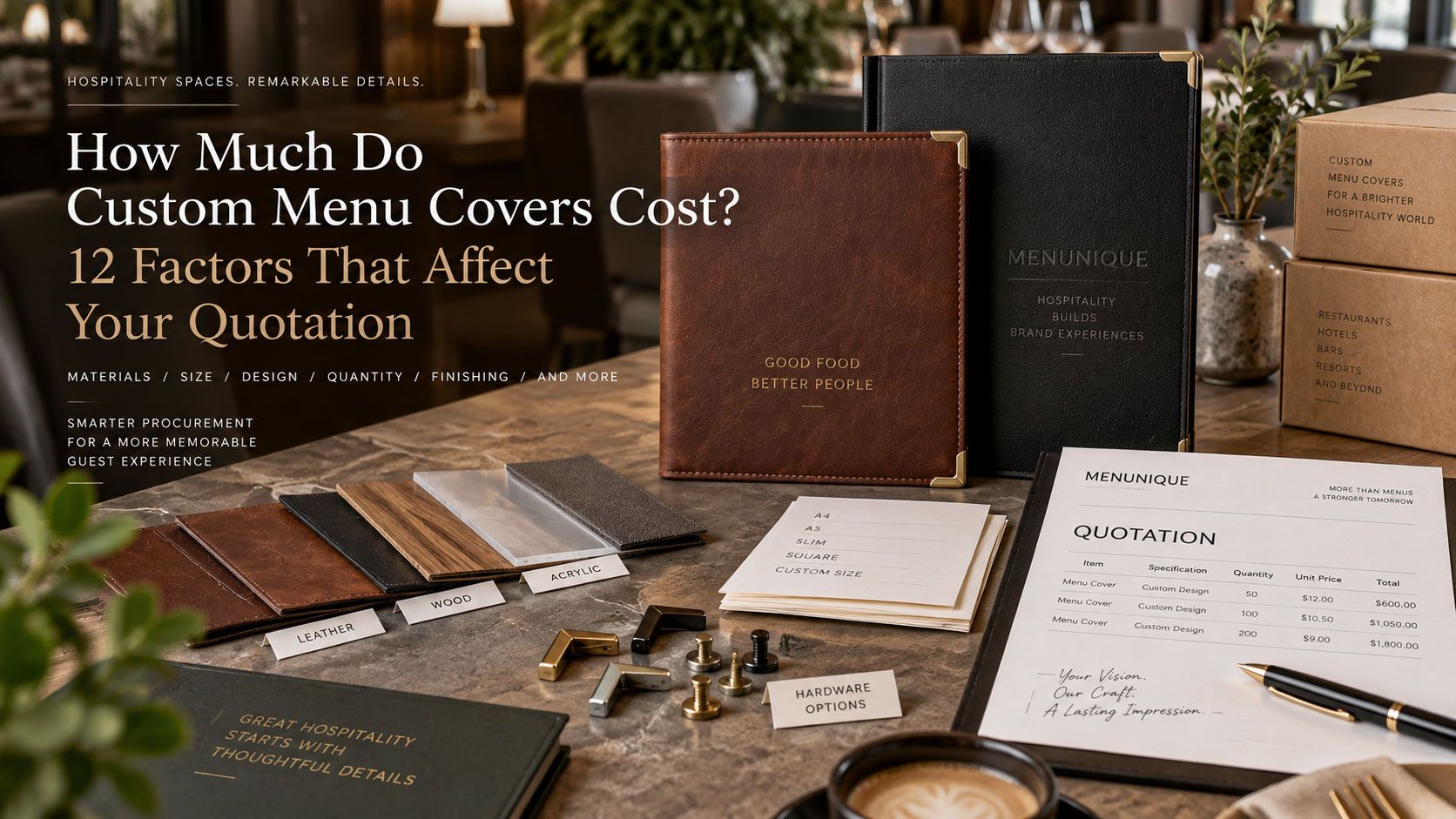
Material names alone are not enough. "Leather menu cover" might mean genuine leather, recycled leather, bonded leather, polyurethane leather, or another synthetic material. Wood species, veneer, board thickness, fabric grade, vinyl thickness, and coating also influence cost.
Ask the supplier to describe the agreed material in writing and provide a physical swatch when color and texture matter. For a hospitality group, approve one labeled master swatch. Digital images can shift with lighting and screen settings.
The internal structure matters too. Board thickness and density affect rigidity, weight, edge appearance, and resistance to warping. A low quote may result from a lighter internal construction that is not visible in a product photo.
3. Size and orientation
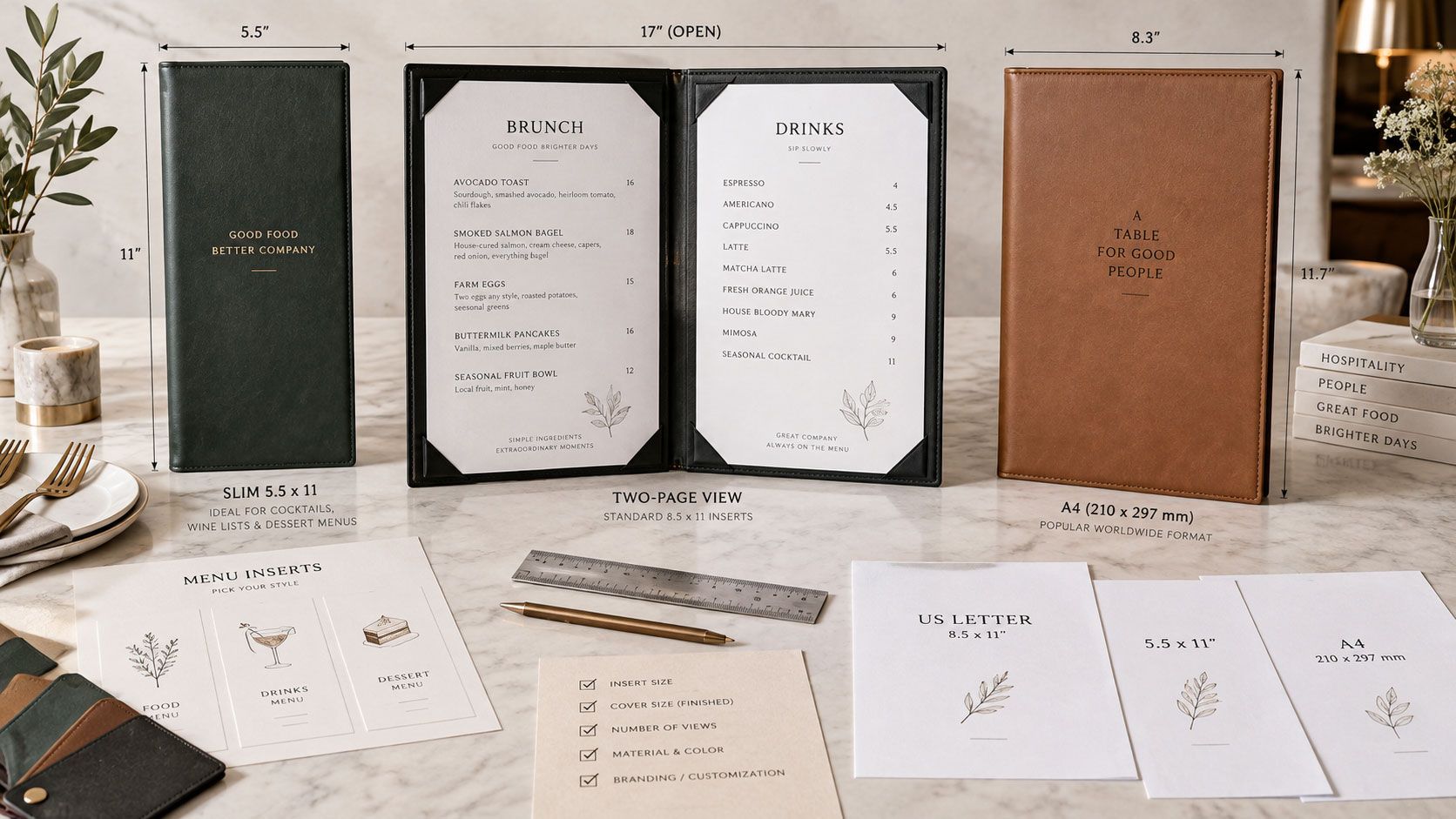
Larger covers use more material and may reduce the number of pieces that can be cut from a sheet. Unusual shapes can create more waste or require special tooling. Landscape, square, narrow, legal-size, and oversized formats may also affect carton efficiency.
Always state whether the quoted size is the insert size or finished outside size. A size misunderstanding can make two quotations appear comparable when they are not.
4. Number of views, panels, or pockets
A two-view cover normally requires fewer components than a six-view or eight-view cover. Each additional panel, clear sleeve, corner set, or pocket adds material and assembly time. More views can also increase packed thickness and freight volume.
Count visible menu faces and request a layout diagram. Phrases such as "four-page," "four-view," and "two-pocket" can be interpreted differently.
5. Binding and hardware
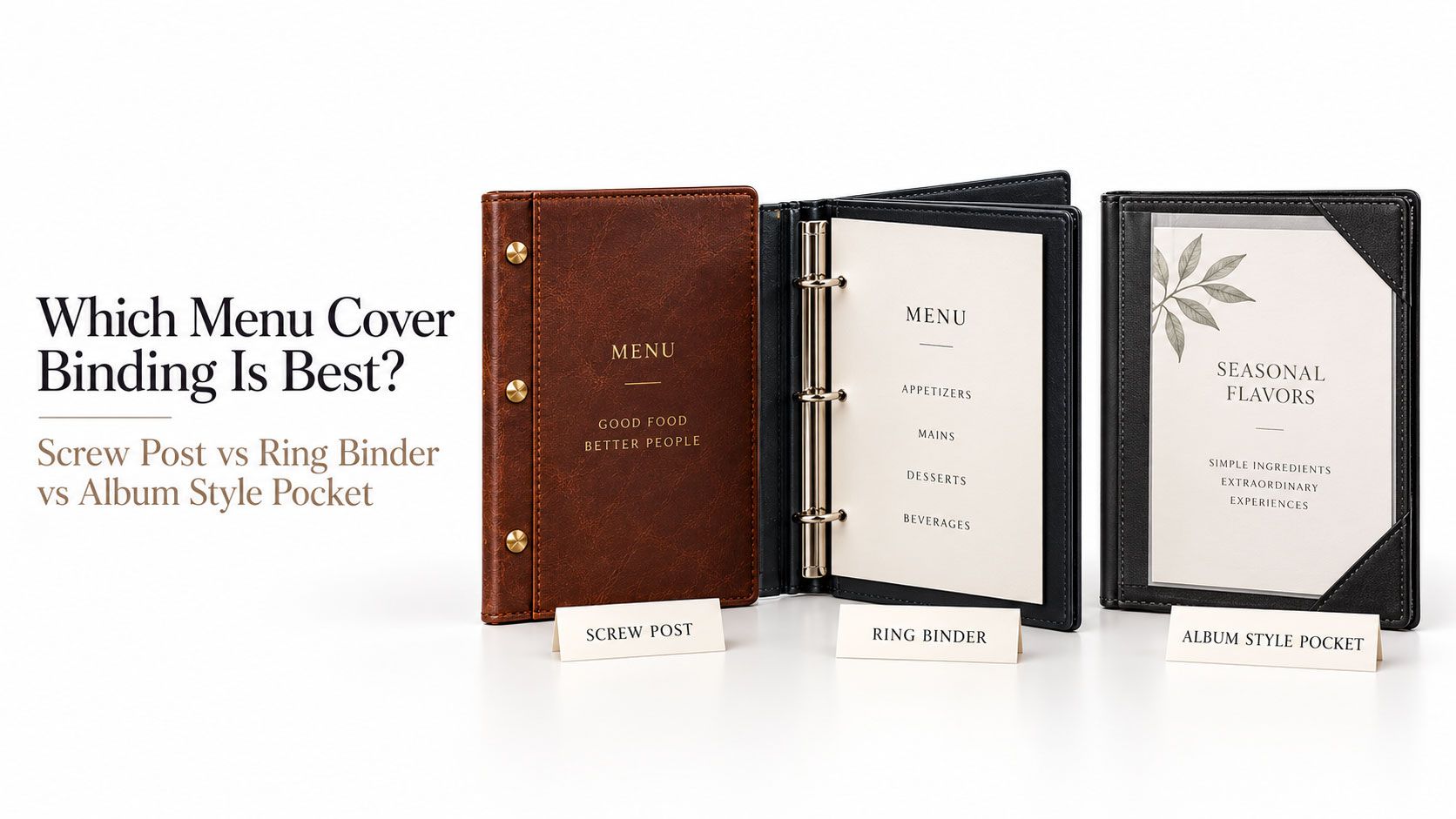
Screw posts, ring mechanisms, clips, magnets, elastic cords, metal corners, and decorative fittings add component cost and assembly operations. Hardware finish and customization can matter as much as the basic type.
Standard hardware is usually more economical and easier to replace. Custom-colored or specially plated metal should be tested for appearance, adhesion, and consistency. For ring binders, specify ring type, ring count, capacity, and spacing. For screw posts, specify location, finish, and required page capacity.
6. Logo and decoration method
Blind debossing, foil stamping, screen printing, UV printing, laser engraving, metal badges, and embroidered branding have different setup and production requirements. Logo size, number of colors, registration tolerance, coverage area, and substrate all affect feasibility and cost.
A small one-position logo is generally simpler than full-surface artwork or multiple branding positions. Supply vector artwork and define the desired physical logo size. Do not rely on a low-resolution screenshot.
7. Custom color and material development
Using an existing material color is generally more efficient than developing a custom color. A specific Pantone target may require material sourcing, ink matching, or a custom production run. Color appearance also changes with texture and gloss.
If exact color is essential, define the approval method. A physical color standard under controlled lighting is more reliable than an email image. Allow time for sample revision if the first match is not acceptable.
8. Order quantity and MOQ
Unit price often decreases as quantity increases because setup and production planning are distributed across more pieces. The relationship is not perfectly linear. Material purchasing units, machine setup, labor efficiency, carton quantities, and hardware pack sizes can create pricing steps.
MOQ varies by construction and material. A standard configuration may support a lower minimum than a custom material, custom metal part, or complex print process. Ask for price breaks at realistic quantities, such as the launch requirement and a likely reorder quantity. Do not request many theoretical quantities that the project will never use.
For MENUNIQUE products, minimums and lead times should be confirmed per product and configuration. The current website may show standard starting values, but a final quotation should govern the project because custom materials, colors, or hardware can change the requirement.
9. Sampling, tooling, and development
A pre-production sample may include material sourcing, artwork setup, logo tooling, hand assembly, and courier delivery. Some costs are one-time; others may apply again if the artwork, size, or construction changes.
Ask whether the quotation includes a visual mockup, material swatch, unbranded construction sample, branded sample, or full pre-production sample. These are different approval stages. A complex order benefits from a sample that uses the actual material, dimensions, hardware, and logo method.
10. Quality control and testing
Quality requirements should be proportional to product risk. Relevant checks may include dimensions, insert fit, color consistency, logo position, stitch quality, edge adhesion, ring operation, screw engagement, pocket welding, opening cycles, surface cleaning, abrasion, and carton drop resistance.
Testing and independent inspection add cost, but unclear quality expectations can add much more through delays or rejected goods. Agree on the specification, inspection sample size, acceptance criteria, and defect definitions before production.
Avoid asking for certificates or laboratory tests that do not relate to the product application. Instead, identify the real failure modes in the restaurant or hotel environment and test those.
11. Individual packaging and carton requirements
Basic bulk packing costs less than individual bags, protective tissue, corner guards, retail boxes, barcode labels, outlet labels, or mixed-location packing. Premium surfaces and metal corners may need separation to prevent rubbing in transit.
For multi-location rollouts, outlet-specific carton labels can reduce distribution errors even if they add packing work. Provide a packing schedule early. Last-minute sorting requests can disrupt an otherwise completed shipment.
12. Shipping method, destination, and trade terms
An ex-factory price is not a landed cost. Freight mode, shipment volume, weight, destination, customs classification, duties, taxes, insurance, local delivery, and Incoterms all influence the final budget.
Ask suppliers to state the currency, quotation validity, trade term, named place, production lead time, packing assumptions, and whether freight is included. Air freight may support a launch deadline but cost more than sea freight. A split shipment can balance urgency and budget, but it adds planning and handling.
How to Compare Quotations Apples to Apples
Create a one-page comparison sheet. Each supplier should quote against the same version number and date.
A supplier that gives a higher but complete quotation may be less expensive than a low quote that excludes tooling, protective packaging, or freight. Clarify every blank rather than assuming it is included.
Calculate Total Cost of Ownership, Not Only Unit Price
Menu covers are working items. Their real cost includes purchase, freight, staff assembly, cleaning, page replacement, spare parts, damage, and reorders.
A low-cost cover can become expensive if inserts are difficult to change, surfaces mark quickly, hardware loosens, or replacement units no longer match. Conversely, a premium construction is not automatically the best value if the menu changes weekly and the binding slows staff.
Consider these operational questions:
For a restaurant chain, a slightly higher unit cost may be justified by faster changeovers and better reorder consistency. For a seasonal venue, a simpler construction may be more appropriate. The purchasing decision should reflect the actual use cycle.
Three Typical Buying Scenarios
Independent restaurant opening
The buyer often needs a modest quantity, a clear launch date, and help finalizing artwork. The most useful cost controls are selecting an existing material, using standard hardware, limiting logo positions, and approving one complete sample quickly. Build a small spare quantity into the initial order so damage after opening does not force an urgent reorder.
Hotel or restaurant group rollout
The project may include several sizes, colors, and outlet labels. Cost depends heavily on specification control and packing schedules. Standardize common components where possible, but do not force every outlet into one unsuitable format. Use a master specification, outlet matrix, approved swatches, and staged shipment inspection.
Distributor or foodservice supplier
The buyer may prioritize repeatability, neutral packaging, SKU labels, and reorder continuity. Price breaks matter, but so do component availability and documentation. Confirm which elements are standard and which are custom so future orders can be planned accurately.
How to Reduce Cost Without Damaging the Result
Cost reduction should come from simplification and planning, not from ambiguous materials or unverified substitutions.
Warning Signs in a Menu Cover Quote
These points do not automatically mean the supplier is unsuitable. They mean the quotation is incomplete and should be clarified before comparison.
Information Needed for an Accurate RFQ
Send the following in one package:
If some details are undecided, identify them as open choices. A supplier can then quote alternatives explicitly rather than making hidden assumptions.
Project Support
Ask for a Product Quotation
Send MENUNIQUE your preferred construction, insert size, quantity, logo artwork, destination, and required date. We will identify missing specifications and prepare a quotation on a clearly stated basis. Ask for a Quotation
Ask for a QuotationFrequently Asked Questions
FAQ
How much do custom menu covers cost per piece?
There is no reliable universal unit price. Construction, material, size, binding, branding, quantity, packaging, and delivery basis must be defined first. Request a written quotation against one specification.
Why does MOQ affect the price?
Artwork setup, tooling, machine preparation, material purchasing, and production planning create fixed costs. At higher quantities, those costs are distributed across more units. Material and hardware pack sizes can also create quantity breaks.
What is a reasonable MOQ for custom menu covers?
It depends on the construction and customization. Standard materials and hardware may support a lower minimum than custom colors, printed surfaces, or custom metal components. Confirm the MOQ for the exact design rather than relying on a category-wide claim.
Are samples free?
Sample policy varies. Stock samples, material swatches, unbranded construction samples, and fully customized samples have different costs. Ask what the sample includes and whether any fee is credited after an order.
How can I reduce the cost of custom menu covers?
Use standard sizes and components, limit variants and logo positions, provide complete artwork, approve one sample efficiently, and plan freight early. Do not reduce cost by accepting undefined materials or skipping fit checks.
What is usually excluded from a factory price?
Potential exclusions include sample courier fees, logo tooling, special testing, individual packaging, freight, insurance, duties, taxes, and destination charges. The quotation should state its Incoterm and exclusions.
What information gives the fastest accurate quotation?
Provide insert size, construction, material, number of views, binding, branding, quantity, destination, required date, and reference images. A vector logo and photos of an existing product can reduce clarification time.
Conclusion
Custom menu cover cost is the result of a specification, not a fixed catalog number. The strongest purchasing process defines the product, obtains comparable quotations, approves a representative sample, and evaluates landed and operating cost together.
An accurate RFQ also saves time. It lets the factory focus on material availability, manufacturing feasibility, lead time, inspection, and packaging instead of repeatedly asking for missing basics. That produces a more trustworthy budget and a smoother path to production.
Next Step
Get a Quote
Tell MENUNIQUE what you are buying, how it will be used, how many pieces you need, and where they must be delivered. We will help organize the specification and quote the relevant options without hiding the assumptions. Get a Quote
Get a Quote