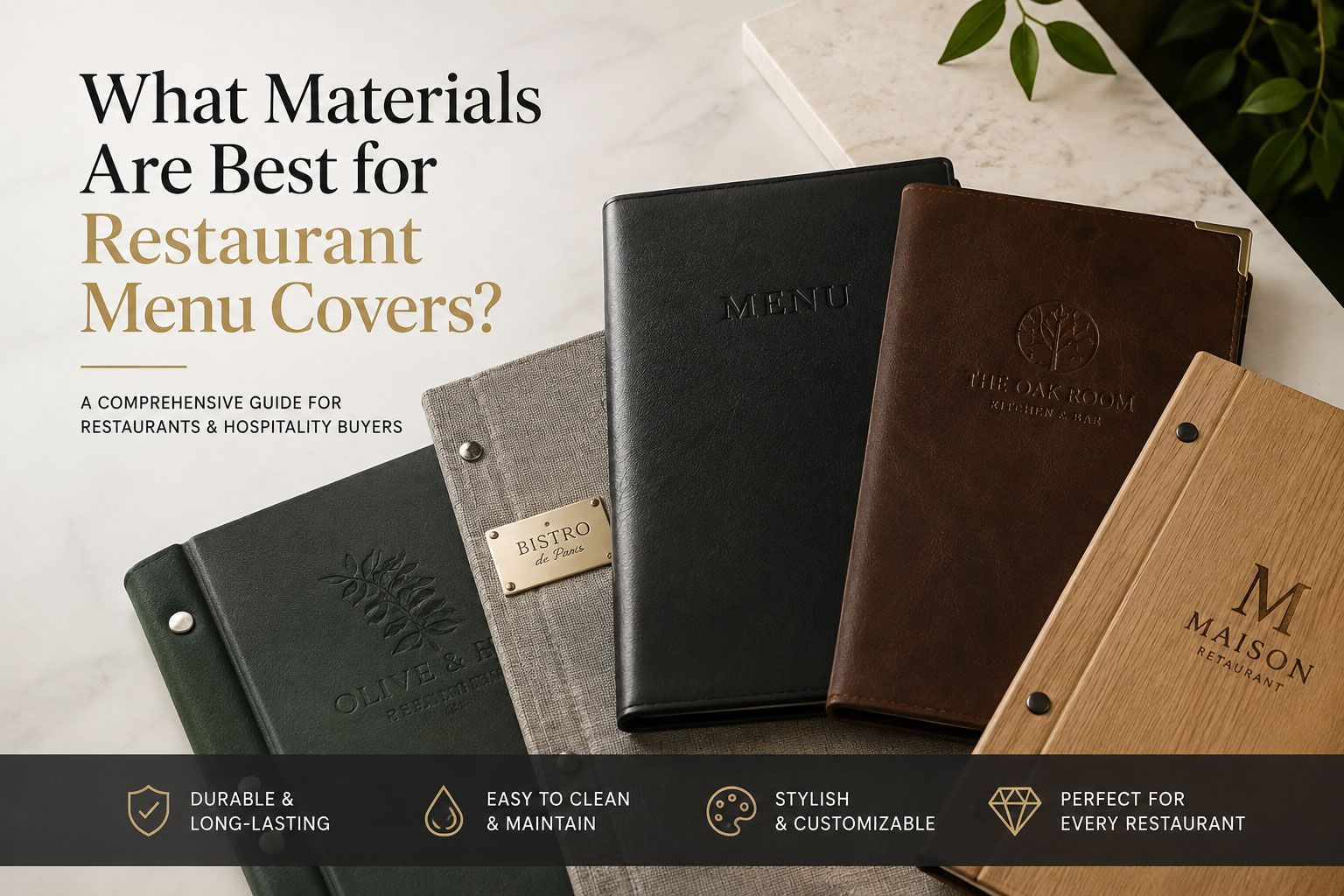
Choosing the right material for restaurant menu covers is about more than appearance. The material affects durability, cleaning, brand presentation, maintenance costs and how often the covers need to be replaced.
For restaurants, hotels, cafes, bars, resorts and hospitality groups, the best menu cover material depends on the operating environment, menu style, budget and desired brand image.
In this guide, we compare the most common restaurant menu cover materials and explain where each option works best.
1. Leatherette Menu Covers
Leatherette is one of the most popular materials for restaurant menu covers because it offers a premium appearance while remaining practical and cost-effective. It is available in a wide range of colors, textures and finishes, making it suitable for both classic and modern restaurant interiors.
Advantages
Best for
For many restaurants, leatherette offers the best overall balance between appearance, durability, customization and price.
2. Genuine Leather Menu Covers
Genuine leather is commonly used for luxury restaurants, boutique hotels, private clubs and premium hospitality venues. It develops a natural character over time and gives menu presentation a distinctive high-end look.
Advantages
Considerations
Genuine leather usually costs more than synthetic materials and may require more careful maintenance. For businesses that prioritize luxury presentation over the lowest possible cost, genuine leather can be an excellent option.
Best for
3. PU Leather Menu Covers
PU leather is a synthetic leather material widely used in custom menu covers. It provides a leather-like appearance while offering good flexibility in color, texture and customization.
Advantages
Best for
PU leather is particularly useful when a buyer needs consistent quality across a large quantity of menu covers.
4. Wooden Menu Covers
Wooden menu covers provide a distinctive natural appearance and are increasingly popular with restaurants that want a rustic, handcrafted, organic or contemporary presentation style. Common options include bamboo, beech, walnut-style finishes, plywood and other engineered or natural wood materials.
Advantages
Best for
Wooden menu covers are particularly effective when menu presentation is intended to become part of the restaurant interior design and brand identity.
5. Acrylic Menu Covers
Acrylic menu covers create a clean, modern and contemporary appearance. They are often used for menu boards, menu holders, table displays and modern menu presentation systems.
Advantages
Best for
Acrylic is especially useful when restaurants want a minimalist design or want the printed menu itself to remain highly visible.
6. Fabric and Linen Menu Covers
Fabric and linen menu covers provide a softer, more decorative appearance. They can work particularly well where the menu cover needs to complement interior fabrics, furniture or a carefully designed hospitality environment.
Advantages
Considerations
Fabric materials may require more maintenance than smooth synthetic surfaces, especially in environments where food and drinks are frequently spilled.
Best for
7. Metal Menu Covers
Metal can be used either as the main menu cover material or as a decorative component combined with wood, leatherette, acrylic or other materials.
Advantages
Best for
Metal is often most effective when used selectively rather than simply replacing traditional menu cover materials.
8. Synthetic and Waterproof Menu Materials
For poolside restaurants, outdoor dining, cafes, resorts and other environments where menus are exposed to moisture, synthetic waterproof materials can be a better solution than traditional menu covers. These materials can often be printed directly and used without a separate protective cover.
Advantages
Best for
Which Menu Cover Material Is the Most Durable?
There is no single material that is always the most durable. Durability depends on material quality, thickness, edge construction, stitching, binding method, frequency of use, cleaning methods and exposure to moisture, food and heat.
For busy restaurants, high-quality leatherette, PU leather, wood, acrylic and synthetic materials can all provide good durability when properly selected for the operating environment. Construction quality is often just as important as the material itself.
For example, reinforced edges, double stitching, quality hardware and properly installed corners can significantly extend the life of a menu cover.
What Is the Best Material for Easy Cleaning?
For restaurants where menus need to be cleaned frequently, smooth and non-absorbent materials are usually easier to maintain.
Textured fabrics and some natural materials may require more careful cleaning. Before placing a large order, buyers should confirm the recommended cleaning method with the manufacturer.
What Is the Best Material for Fine Dining Restaurants?
Fine dining restaurants often prioritize tactile quality, visual presentation and branding. Popular choices include genuine leather, premium leatherette, wood, fabric or linen, and mixed-material designs. The best choice should complement the restaurant interior, menu design, tableware and overall brand positioning.
What Is the Best Material for High-Volume Restaurant Chains?
For restaurant chains, consistency, cleaning, durability and price are usually more important than using the most expensive material.
These materials can be produced consistently in larger quantities and customized with brand colors, logos and standard sizes.
How Should You Choose a Menu Cover Material?
Where will the menu covers be used?
Indoor fine dining, outdoor dining, poolside service, cafes and hotel restaurants all have different requirements.
How often will they be handled?
High-turnover restaurants need materials that can withstand frequent opening, closing, cleaning and replacement of menu inserts.
How frequently does the menu change?
Restaurants that update menus regularly may prefer screw post, ring binder, cafe-style pocket or other easy-change constructions.
How important is branding?
If logo presentation is important, consider whether the material supports debossing, embossing, foil stamping, screen printing, UV printing, laser engraving or metal logo plates.
What is the target budget?
Material selection should be evaluated based on total lifecycle cost rather than unit price alone. A slightly more durable menu cover may reduce replacement frequency and provide better long-term value.
Material Comparison at a Glance
Custom Menu Cover Materials from MENUNIQUE
MENUNIQUE provides custom menu cover solutions for restaurants, hotels, cafes, bars, resorts, hospitality groups, distributors and other foodservice businesses.
Depending on the project, menu covers can be customized in terms of material, color, texture, size, insert format, binding construction, corner style, interior finish, logo process and packaging.
Different restaurant environments require different materials, so there is no single solution that fits every project. For buyers planning a new restaurant opening, hotel project, chain rollout or menu cover replacement program, comparing material samples before production is often the most practical way to make a decision.
Frequently Asked Questions
What is the most popular material for restaurant menu covers?
Leatherette and PU leather are among the most widely used materials because they provide a good combination of appearance, customization, durability and cost.
What menu cover material is easiest to clean?
Smooth PU leather, leatherette, acrylic and synthetic waterproof materials are generally easier to wipe and maintain than absorbent materials such as fabric.
Are wooden menu covers durable?
Yes. Properly manufactured wooden menu covers can be highly durable, although their performance depends on wood type, surface finish, hardware and operating environment.
What material is best for luxury restaurants?
Genuine leather, premium leatherette, wood, fabric and mixed-material constructions are commonly used for luxury restaurant menu presentation.
Can menu covers be customized with a restaurant logo?
Yes. Depending on the material, common branding methods include debossing, embossing, foil stamping, printing, laser engraving and metal logo plates.
What is the best menu cover material for outdoor restaurants?
Water-resistant synthetic materials, selected PU materials, acrylic and other easy-clean surfaces are often better suited to outdoor environments than absorbent materials.
Conclusion
The best restaurant menu cover material depends on the restaurant environment, branding requirements, menu format, cleaning frequency and budget.
Leatherette and PU leather are strong all-round options for many hospitality businesses. Genuine leather works well for luxury positioning, wood offers a distinctive natural appearance, acrylic provides a modern look, and waterproof synthetic materials are particularly useful for outdoor and high-moisture environments.
For B2B buyers, the most effective approach is to compare materials not only by appearance, but also by durability, maintenance, customization options and long-term cost. A well-selected menu cover material should support both daily restaurant operations and the overall brand experience.