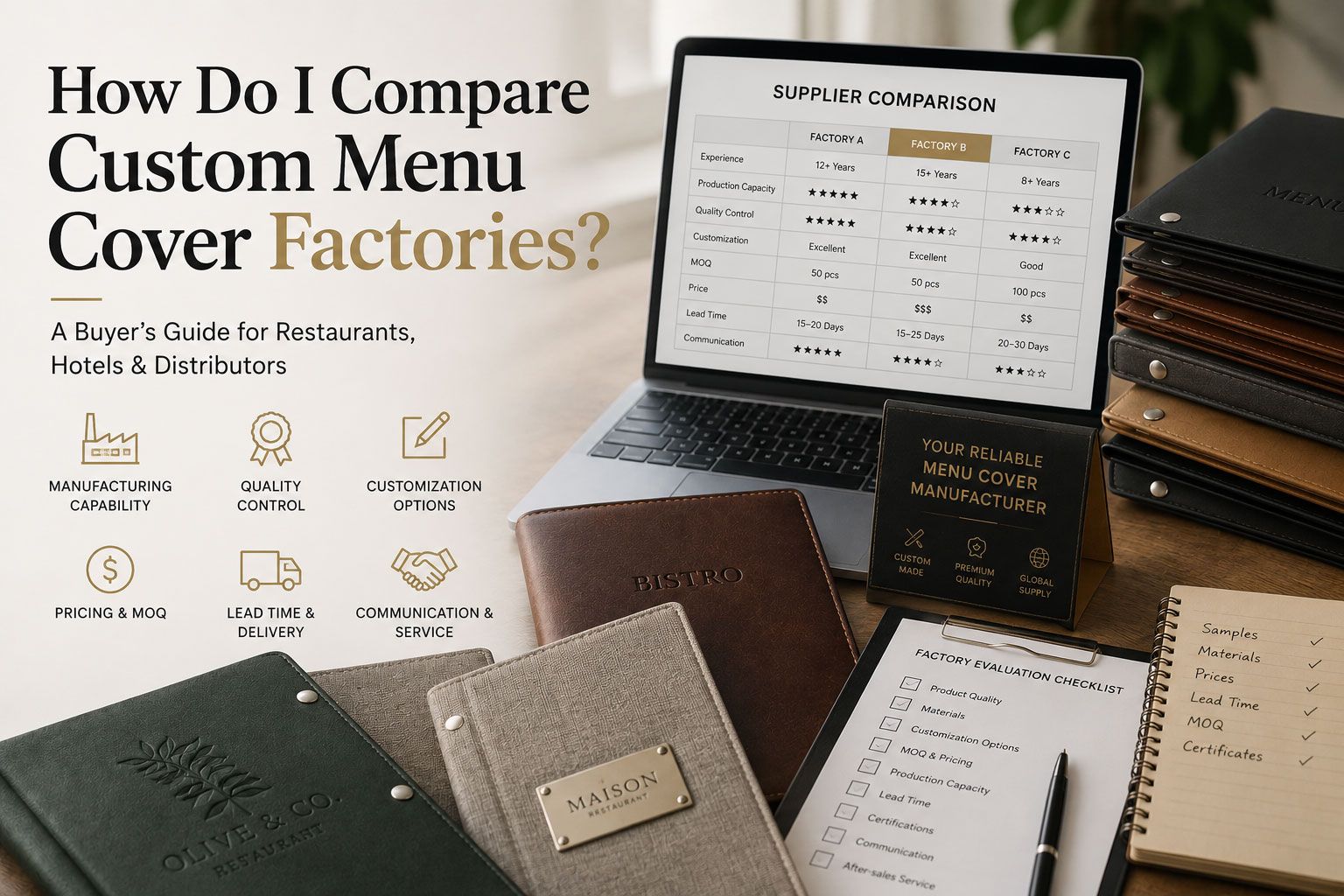
Choosing a custom menu cover factory is not only about finding the lowest price. For restaurants, hotels, hospitality groups, distributors and foodservice buyers, the right supplier should be able to deliver consistent quality, flexible customization, reliable lead times and stable service across repeat orders.
If you are comparing multiple custom menu cover factories, the most effective approach is to evaluate them using the same criteria instead of relying only on quotations. This guide explains what B2B buyers should compare before placing an order.
1. Start with Manufacturing Experience
The first question is whether the supplier actually understands menu cover production. A factory with experience in hospitality presentation products should be familiar with:
A supplier that only produces general leather goods or promotional products may not understand the details that affect menu cover performance.
Ask
Relevant experience reduces the risk of production mistakes.
2. Compare Product Range
A factory with a wider menu cover product range may be better equipped to support different restaurant concepts and future projects.
This does not mean the factory with the largest catalogue is always the best. The more important question is whether the supplier is strong in the specific construction you need.
For cafe menu covers, compare stitching quality, pocket construction, trim materials, corners, insert fit and durability. For screw post menu covers, compare the spine construction, post hardware, page capacity and ease of changing inserts.
3. Compare Material Options
Material selection directly affects appearance, durability, cleaning and price. A capable custom menu cover factory should be able to explain the advantages and limitations of different materials, rather than simply sending a long material list.
When comparing suppliers, ask
Material consistency is especially important for restaurant chains, hotel groups and distributors placing repeat orders.
4. Compare Customization Capabilities
Customization is one of the most important differences between factories. Do not only ask whether customization is available. Ask exactly what can be customized.
The best supplier is not necessarily the one offering the most options. It is the one that can clearly explain which options are suitable for your product and budget.
5. Compare Logo and Branding Processes
For many hospitality buyers, the menu cover is part of the brand experience.
When comparing factories, ask for physical samples of the logo processes you are considering. A digital mockup can show placement and approximate appearance, but it cannot fully show foil quality, embossing depth, edge sharpness, surface adhesion, color consistency or fine-detail reproduction.
For branded hospitality products, logo quality should be evaluated as carefully as the menu cover itself.
6. Compare Sample Quality Before Comparing Mass Production
A sample is one of the most useful tools when selecting a supplier. Check:
Do not only ask whether the sample looks good. Compare the sample directly against your specification. If you are evaluating multiple factories, use the same checklist for each supplier.
7. Compare Quality Control Systems
Consistent quality is more important than one perfect sample. Ask how the factory controls quality during production.
For large projects, ask whether the supplier can provide inspection photos, reports or third-party inspection support before shipment. This is especially important for distributors and hospitality groups that need consistency across repeated orders.
8. Compare MOQ
Minimum order quantity can vary significantly depending on material, construction, custom color requirements, logo process, hardware, packaging, order size and production method.
A low MOQ can be useful for new restaurant openings, boutique hotels, product testing, small distributors and new brand launches. However, buyers should not compare MOQ alone.
A very low MOQ may come with higher unit cost, limited materials, limited colors, restricted customization or longer production arrangements. Ask suppliers to explain how MOQ changes with different specifications.
9. Compare Pricing Correctly
The cheapest quotation is not always the lowest-cost solution. Before comparing prices, make sure all factories are quoting the same specification.
For example, one supplier may quote thinner materials, simpler hardware or standard packaging while another includes upgraded specifications. A proper factory comparison should be based on comparable products.
10. Compare Production Lead Time
Lead time is especially important for new restaurant openings, hotel renovations, chain rollouts, seasonal promotions, trade show projects and distributor replenishment.
Ask
A realistic lead time is more valuable than an aggressive promise that cannot be maintained.
11. Compare Production Capacity
For small orders, capacity may not be important. For chains, distributors, hotel groups and large hospitality projects, it becomes critical.
A supplier should be able to explain how production capacity changes during busy periods.
12. Compare Communication Quality
Good communication is often overlooked when selecting a factory. Before placing an order, evaluate how the supplier handles specifications, questions, artwork, revisions, samples, production updates, packaging instructions, shipping documents and problems.
A supplier that responds quickly but inaccurately can still create problems. Look for communication that is clear, specific, consistent, technically accurate and well documented. For custom products, strong communication can prevent expensive production errors.
13. Compare Technical Understanding
A good factory should be able to identify potential problems before production.
A supplier that simply says yes to every request may not always be the safest choice. Technical feedback is often a sign of manufacturing experience.
14. Compare Packaging
Packaging matters because menu covers can be damaged by scratching, crushing, moisture, hardware contact and surface abrasion.
Ask how the factory packs individual products, foil-stamped products, acrylic products, wooden products, metal hardware and export cartons.
For distributors or retail-ready products, you may also need custom boxes, barcodes, labels, polybags, master carton markings and private-label packaging.
15. Compare Export and Shipping Experience
If you are buying from an overseas factory, export experience matters. The supplier should understand commercial invoices, packing lists, HS codes, carton markings, freight forwarder coordination, Incoterms, export packaging and customs documentation.
Ask which countries the factory regularly ships to. A factory familiar with your destination market may reduce communication and documentation problems.
16. Compare Compliance Support
Depending on your market and product material, you may need documentation related to material safety, restricted substances, Prop 65, REACH, packaging requirements or wood-related import requirements.
Not every product requires the same compliance documentation. Ask the factory what test reports or declarations are available for the materials you intend to use. Do not assume that one compliance document automatically applies to every material or product.
17. Compare Repeat-Order Consistency
For B2B buyers, the second order is often more important than the first. Ask how the supplier records material codes, colors, dimensions, logo artwork, hardware, packaging and production specifications.
This is particularly important for restaurant chains, hotel groups and distributors. A reliable supplier should be able to reproduce the same product months later with minimal variation.
18. Compare Problem-Solving Ability
Problems can happen even with experienced factories. What matters is how the supplier responds.
A professional supplier should have a clear process for investigating and resolving quality issues.
Custom Menu Cover Factory Comparison Checklist
Use the following points as the same comparison checklist for every supplier you shortlist:
What Questions Should I Ask a Custom Menu Cover Factory?
Should I Choose a Factory or Trading Company?
Both can work, depending on the project.
A direct factory may offer
A trading company may offer
The right choice depends on whether your priority is specialized manufacturing or broader sourcing support.
Is the Lowest-Price Factory the Best Choice?
Usually not. Low pricing can be attractive, but buyers should also consider material quality, production consistency, logo quality, lead time, communication, packaging, replacement risk and repeat-order consistency.
The best factory is usually the supplier that offers the best overall balance of quality, customization, reliability and price.
How Many Factories Should I Compare?
For most B2B projects, comparing three to five qualified suppliers is usually enough. Too few suppliers may limit your options, while too many can make the process inefficient and difficult to manage.
Start with a larger list, then shortlist factories based on experience, capability, responsiveness, sample quality, pricing and technical understanding. Then compare the final candidates using the same evaluation criteria.
Final Thoughts
Comparing custom menu cover factories should be a structured procurement process, not simply a price comparison. The strongest supplier should be able to demonstrate relevant manufacturing experience, suitable materials, strong customization capabilities, consistent sample quality, reliable quality control, reasonable MOQ, competitive and transparent pricing, realistic lead times, stable production capacity, clear communication, export experience and repeat-order consistency.
For restaurants, hotels, hospitality groups, distributors and other B2B buyers, selecting the right factory can reduce production risk and make future reorders much easier. A good supplier should not only manufacture the product you specify. It should also help identify better materials, construction methods, branding options and production solutions for your application.
About MENUNIQUE
MENUNIQUE specializes in custom menu covers and hospitality presentation products for restaurants, hotels, cafes, bars, resorts, hospitality groups, distributors and foodservice businesses. Our customization capabilities include materials, colors, sizes, page styles, binding systems, hardware, logo processes and packaging.
Buyers evaluating custom menu cover factories can request material samples, product samples and quotations based on their project requirements.